


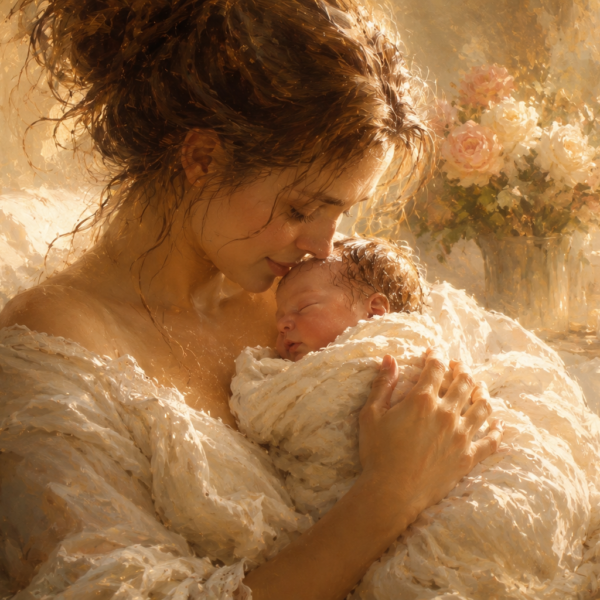





For this birth, I had promised myself I would approach it differently. I wanted to move with the pain of the contractions by consciously trying to relax into them. How exactly I was supposed to do that, I didn’t really know—but I was determined to try. I had read that it could make labour progress faster, and that was exactly what I hoped for.
That evening, as I realised I didn’t even have a single photo of my pregnant belly, I asked Wordfather to take one. Less than two hours later, around eleven o’clock, the contractions began. I called my mother, who was going to help with the postnatal care. When she arrived, Wordfather and I left for the hospital. The contractions quickly started coming one after another. In my attempt to stay relaxed, I tried not to clench my hands into fists, but to keep them open, my fingers stretched out.
When we arrived at the hospital, I was told it didn’t look like I was in labour yet and that we should come back when things became more intense. Back at home, my mother was surprised to see us return. What could we do but wait? I waited for it to get worse—but it didn’t get worse. It was already intense. And then, suddenly, my waters broke, and immediately after that, the urge to push took over. Panic set in. What now?
We called the midwife, who promised she would come as quickly as possible, but the minutes felt like hours. It was around three in the morning by then. My mother joined us, and I stood there, leaning on both her and Wordfather, trying to hold on. The urge to push was almost impossible to resist—it felt so unnatural to hold it back. I don’t remember who looked first, but the baby’s head was already visible. Finally, the midwife rushed in, pulled on her gloves, and I asked, “Can I?” She said, “Yes.” And just like that, she was born—her hand raised above her head like a tiny superhero.
I had been completely unprepared for the birth. There was nothing ready in the house. While everyone ran around in a kind of frantic chaos, searching for whatever they could find, I lay there—half in shock, half in awe. And there she was, being weighed… on top of the puzzle I had been working on for days.
It didn’t take long before she was nicknamed “Puzzle Child,” and later “Riddle Daughter.” And she truly was. With her, everything felt like a puzzle—constantly trying to figure out what worked and what didn’t in raising her. My eldest had been an open book, easy to talk to, easy to guide. But she was entirely different—a mystery in her own right. Two completely different children.
The next morning, Professor Son jumped excitedly onto the bed, shouting that he had become a big brother. The news had clearly touched him, as if he had taken an important step in his young life. His joy filled the room, and we shared that same sense of happiness. A new chapter had begun for all of us.
It brought me back to my own childhood, when I was nine years old and my mother was pregnant. I remember feeling that same excitement, that same anticipation. Just like Professor Son, I couldn’t wait to step into my new role as a big sister. Curious as I was, I devoured every book and article I could find about babies. I was so enthusiastic that I even gave a presentation about it at school—and scored a nine!
When my little sister was finally born, I was overjoyed. My brother, however, felt quite differently. He didn’t like it at all, and it didn’t take long before arguments followed. As my sister grew older, she began to irritate me more and more. My mother explained it by saying I was becoming a “touch-me-not plant.” She always had a proverb or saying ready to explain everything, which is why I started calling her “the proverb mother.”
My little sister didn’t make it easy either. She would constantly take my things, only to enthusiastically help me search for them afterwards. Strangely enough, we always ended up finding them behind the toilet. Whether that was magic or a clever trick, I’ll probably never know.
On weekends, she would crawl into my bed early in the morning. I was about twelve by then, she around three, and while all I wanted was to sleep in, she would chatter endlessly. Puberty had taken hold of me, and my favourite activity had become sleeping. Still, it was my job to look after her in the mornings. It often felt like I had a human alarm clock with no snooze button.
These memories of my childhood began to blend with my experiences as a mother. The pain of my recent birth faded quickly, and by the second day after giving birth, I was already walking through a garden centre, buying Mother’s Day gifts. It felt as though I had my body back again. I was relieved to feel like myself, without the physical limitations that pregnancy had imposed on me for so long.
What still moves me deeply is that my mother was there during the birth and stayed with us during those first days after. I carry that in my heart. Those first ten days flew by, but in that time, we were able to truly bond—to just be together. Because after that, life quickly returned to its rhythm, now with two children. The chaos of everyday life took over, but those first moments of pure connection remain with me.
I also cherish the memory of calling my grandmother that week, overflowing with everything that had just happened. I told her all about the birth—how quickly it had gone, and especially how I had given birth standing up. She listened carefully, and when I finished, she said something that stayed with me:
“You are such a primal woman—giving birth standing up. That is the power of nature.”
Her words hit me deeply. She gave me a sense of pride, of connection to all the women who had come before me. And you know what? She was right. It is actually quite unnatural for women to give birth lying down, working against gravity. Giving birth standing up felt so much more aligned with what my body wanted to do—as if I had rediscovered an ancient wisdom within myself.
The fact that my grandmother recognised that and gave it a name made it even more meaningful. It felt like a confirmation of something I had always known deep inside: that there is a strength in women far greater than we sometimes realise. ❤️
Geef een reactie