









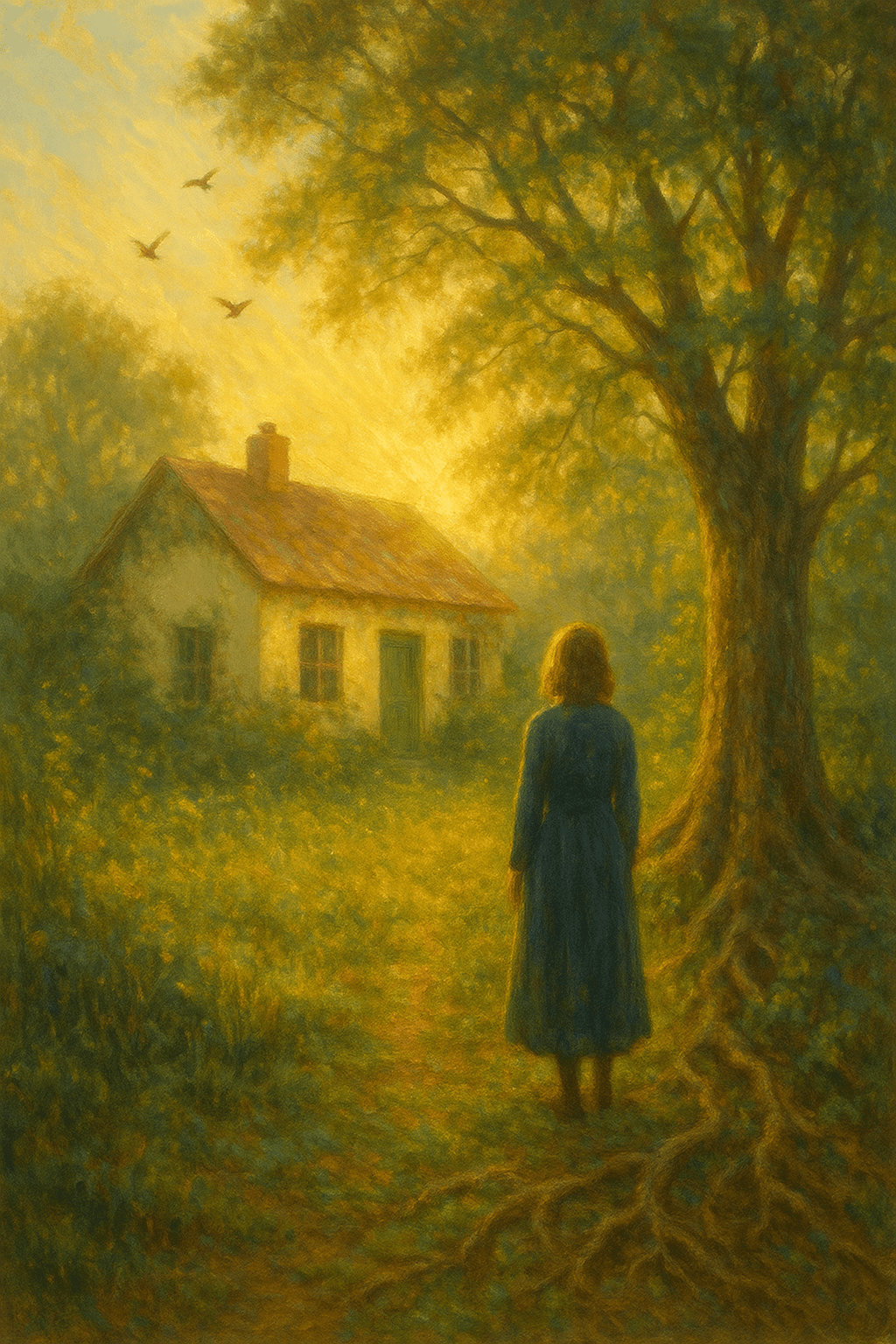

It was autumn when everything changed. We had bought our dream home. The garden stretched deep, the air was crisp, and the scent of freshly cut grass filled my lungs. Here, in this place, everything felt right. It was as if the house had been waiting for us, ready for a new beginning.
Two months earlier, in the summer, I had discovered that picturesque village, just a twenty-minute drive from my sister and my parents. What immediately caught my attention was a charming little house near the village centre. Crossing a small bridge, walking past the church, you would suddenly find yourself among the shops. Across from the house was a school, and between them a strip of green where sheep grazed peacefully. Zen—the perfect balance between countryside and town. Best of all: we could afford it.
Once the keys were handed over, it felt as though a door to a new world had opened for us. As I walked through the empty rooms, I could already hear the children’s laughter echoing in my mind. This would be their place—the space where they would run, play, and grow up. I felt so happy, so full of joy.
And that garden… I knew instantly: this will be our safe haven. Here, we would find peace, away from the chaos. Here, sitting on the terrace with a cup of coffee, I would finally be able to breathe again.
At the start, all the gardens were separated by fences, but at the far end they opened up, allowing the children to move freely between them, playing together from yard to yard. It reminded me of my own childhood. Back then, my neighbourhood was a paradise for a child. We dug holes in the sandbox and turned them into little dens, covering them with sheets. After dinner, we played “buskruit,” a wild mix of football and hide-and-seek. We played curb games, roller-skated, skipped with elastics, or hopped across chalk-drawn patterns. Every day was a new adventure on the pavement. That was what I wanted for my children too.
The desire to live closer to my sister and my parents had slowly grown while living in the big city. I dreamed of more space, a larger garden, perhaps a decorative garden or even a vegetable patch—somewhere the children would have room to play. Away from the noise of the city, closer to nature.
That longing for a big garden had roots in my own childhood. My grandfather had a beautiful vegetable garden, and I often went with him to help. It was a place full of scents, colours, and calm, where everything seemed to grow in perfect harmony. One time, I brought along my faraway-adventure friend, who was always up for something new. My grandfather asked us to take some garden waste to the compost heap, and we happily did—until we suddenly saw a snake. Startled, we ran, our hearts pounding in our throats. But my grandfather, ever calm, waved it off. “Oh, don’t be silly, it’s probably just a viper,” he said casually. Well, you can imagine that I didn’t go near that compost heap again after that.
My grandfather was always pleased when I had “loan ponies”—ponies I was allowed to care for as if they were my own, even though they belonged to someone else. Not only because he knew how much I loved it, but also because he was quite fond of the manure for his vegetable garden. “Ask if I can take some of the manure,” he would often say, with a mischievous twinkle in his eyes. Usually, that was fine. Later, sitting at the table, he would take a bite of his broad beans and grin, saying, “Oh, these taste so good thanks to Loan Pony Number Three.” Yuck, I would think—yet I always laughed at how effortlessly he wove the cycle of nature into his humour.
My mother-in-law, however, was far from pleased that we would be moving two hours away from her. During a car ride to the garden centre, she made it very clear that her son would never leave the city where she lived. Still, I stood my ground—something that was not appreciated. This house felt right in every way. It was the place where I saw us living, growing, building a future. This time, I would not give up.
The first setback came when we tried to sell our house in the city. The estate agent, who had previously claimed that the foundation issues were no problem at all, suddenly acted as if the house was unsellable. But I refused to be discouraged. Determined, I took photos myself and placed an ad online. For a small fee, our house was listed—and within a week, there was already a response. A man who wanted to live close to his sister showed interest and came to view the house. He saw the renovated extension, perfect as an extra bedroom, and decided to buy it.
It felt like a huge victory.
When I told the estate agent I had sold the house myself, his surprise was unmistakable. A thought crept in—one I could never prove and still don’t know if it’s true. My mother-in-law knew this agent very well… So why had our house suddenly become “unsellable”?
By the time we had truly settled into our dream home, autumn had fully arrived. The house was small—everyone had an opinion about that—but I didn’t care. What others saw as limitation, I saw as possibility, especially with the long garden. I immediately imagined extending the house. Wearing my grandmother’s old coat, with a warm cup of coffee in my hands, I walked into the garden, already making plans in my head. A trampoline could go here, a cosy terrace there.
It was a beautiful autumn day—the air crisp but not cold, the sunlight soft. I sank into a garden chair, letting my face rest in the warmth of the sun, and allowed my thoughts to drift.
How did I end up here? Is this paradise?
We enjoyed the house, the space, the quiet it offered us. And yet, beneath it all, there was an undercurrent I couldn’t ignore. While I tried to feel at home in this new place, Wordfather commuted daily back to our old city for work. Four hours a day—two hours there, two hours back. We hardly saw each other, and more and more, I felt like I was carrying our family life on my own.
Every evening, I cooked twice: once for the children, and then again for him when he came home around eight. Sundays were always reserved for my mother-in-law. No matter how much it frustrated me, I couldn’t change it. Those Sundays meant I barely had time left for my own family. I felt like I was constantly running, always busy, never stopping—never having a moment for myself. Time for me—for rest, for breathing—simply no longer existed.
The tension between us kept growing, like a storm that never quite breaks but is always there, hanging in the air. Slowly, without realising it, we began to drift apart.
And it felt familiar.
As if I had lived this before.
As if I was slipping back into the pattern of my previous relationship. ❤️
Geef een reactie