









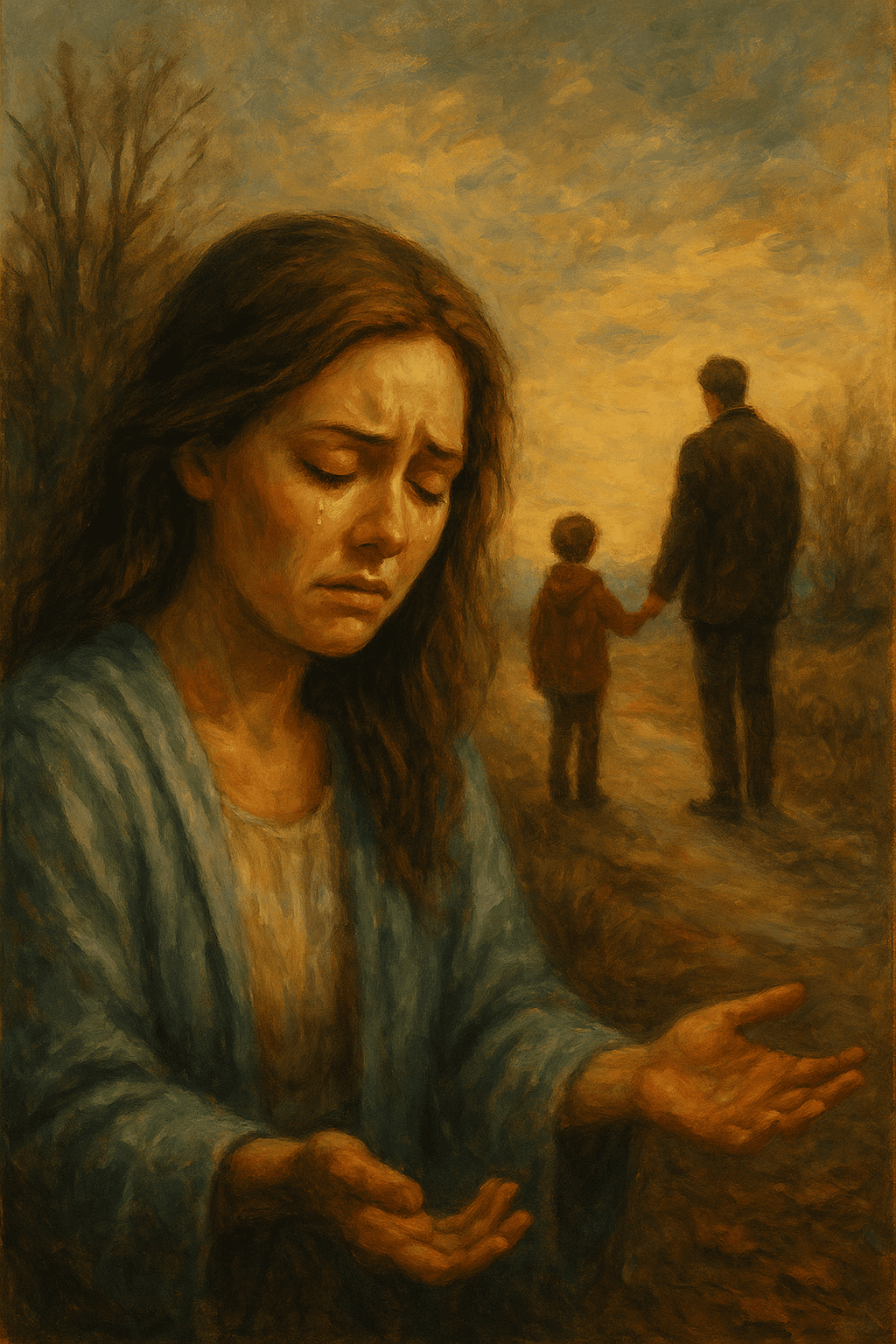

The day finally came when Wordfather and I decided it was over. It was one of those moments you always knew might come someday, yet secretly hoped never would. I spoke the words, and he agreed. There was a tiredness in his voice, a kind of resignation that almost hurt to hear. “No one can say that you and I didn’t try to make it work,” he said, as if those words could offer comfort. But they sounded hollow, empty. It simply didn’t work. We told ourselves we would part as friends, the way people often say, but I felt anything but friendly. We agreed he would stay in the house for one more month so the children could slowly adjust. Oh God… the children. The conversation we still had to have with them felt like an impossible mountain to climb.
That afternoon, everything exploded. Professorson reacted with anger, a fierce, burning rage that tore through the room like a storm. Riddle Daughter just looked at me and nodded, but her eyes held all the questions and pain she couldn’t put into words. I felt myself freeze, as if my body went numb from the shock. Wordfather’s voice echoed somewhere in the background, trying to say something that might comfort, but none of it reached me. It all felt like failure, like an irreversible mistake we had placed on our children’s shoulders. Eventually, the storm in Professorson’s eyes settled, but the silence that followed was even more unsettling. The days after that felt strange, filled with awkward silences and conversations that led nowhere. Something hung in the air—unspoken, heavy—and it felt as though we were all waiting for something worse to happen. One day, Wordfather announced he was going to his mother’s, just for the day. When he returned, there was something about him I immediately recognised: a coldness, like a gust of icy wind, as if he hadn’t come back alone but had brought her voice and influence back with him.
He paced through the room, pointing his finger in the air, and said firmly, “I have full support from my family, financially as well.” His words lingered, heavy with meaning, and there was a tone of satisfaction in his voice I knew all too well. “I also know a lot of people with expertise—I’ll reach out to them,” he added, as if he had already mapped out a strategy. He stood in front of me, hands on his hips, like he had already won something. Then, without another word, he turned and walked upstairs to go to bed, his footsteps echoing in a way that stayed with me long after. At that time, I had no contact with my own family. A conflict with my mother had created a painful distance after I couldn’t attend her birthday because Wordfather had surgery that day. That moment had deepened a crack that perhaps had always been there. She supported my brother and sister, but with me there was always this silence, as if she believed I could manage on my own. But I didn’t feel strong at all. Financially, I had my disability benefit, thankfully, but fear crept in—fear that his mother would use her money and power during the divorce, that she would be stronger, more influential. My courage drained away. I wasn’t alone, yet I felt weaker than ever.
At night, when the house was quiet and everyone was asleep, I allowed myself a few glasses of wine. It became a ritual, a lifeline—my way to breathe, to empty my mind, to create some distance from the pain. People might judge that, might call me an alcoholic, but that judgment doesn’t touch me. Let them think what they want. The wine was a conscious choice, something that felt like the least harmful way to cope, instead of painkillers, sleeping pills, or Oxazepam—things Wordfather would have preferred to see me use, because it would have fit the image of a woman who couldn’t cope, a woman losing herself. But I refused that path. I chose wine, openly, without hiding it. Others empty bags of chips or reach for other forms of comfort—this was mine. It helped me survive. It helped me stand in a world that often felt too heavy.
The divorce itself became a nightmare—the kind you feel deeply ashamed of, the kind you don’t even want to admit to yourself. Wordfather, once my partner, became someone who knew exactly where to hurt me the most. Every word, every action seemed designed to hit my most vulnerable spots. His mother did indeed pull out her credit card to fully furnish his new place—not a modest apartment, but a fully equipped guesthouse in the countryside. One month turned into two weeks before he moved out. Meanwhile, I was the one writing the parenting plan, hoping we could still raise our children together despite everything. But he didn’t stick to any of it. I divided our belongings, packed his things, arranged everything that needed to be done, while he did nothing except withdraw fifty euros every single day. With each transaction, my anxiety grew. Would there still be enough to pay the mortgage? Would we have food? The panic became constant, keeping me awake at night. When I sought help from a lawyer, I was told it was all legal—he was allowed to withdraw that money. It felt like a slap in the face. He spent money on outings with the children while I tightened every financial string just to keep us afloat.
Then came another blow. By accident, I saw an email written by his sister’s husband. The words burned into me: “Are you finally rid of that b*tch?” That’s what I was to them. It cut deep, reducing my entire being to that one cruel word. Around that same time, there was a school-organised mother-daughter trip to Paris. It could have been something beautiful for me and Riddle Daughter, something meaningful. But before I even had the chance, Wordfather had already signed himself up to go with her. My heart shattered—not just because I couldn’t afford it, but because something so special was taken from me. Determined to still create something meaningful, I planned a day out with the children. I had spent weeks collecting discount coupons for train tickets and entry to the Omniversum in The Hague. That day meant everything to me. For a moment, it was good again—we laughed, we enjoyed it. But even that moment was overshadowed. He kept messaging Riddle Daughter about Paris, slowly pulling her attention away. Even then, it felt like he was taking something from me.
There came a point when Professorson no longer wanted to go to his father on weekends. He resisted the constant packing, the moving back and forth, the lack of stability. I saw his struggle, his longing for peace, and yet I insisted he go. “It’s important for your bond,” I told him—and I meant it. I even said I had things to do that weekend, that it would be good for all of us. But that wasn’t the truth. It was a lie I told to convince myself. In reality, I often had nothing. Just like in those first weeks when the children started daycare, I made plans in my head but did nothing. The silence was overwhelming, impossible to fill. Sometimes I went out with another mother I knew, but even those outings felt like an escape rather than joy. Every handover became a battle—arguments about agreements not kept, expectations never spoken but always felt. The moment the door closed behind Professorson and Wordfather’s car drove away, the tears came. I would close the curtains, turn off the lights, curl up on the couch in a fetal position. As if my body wanted to return to a place where everything felt safe. Then came the flood of tears, unstoppable, carrying all my frustration, sadness, and helplessness. What a mess. What an absolute mess. Will this ever stop? I felt empty, exhausted, powerless. Why did I let myself be triggered like this? Why couldn’t I be stronger?
Life shifted in many ways during that time. The babysitting arrangement with the technical friend ended as they both moved on to secondary school—the end of the “three musketeers,” the closing of a chapter. And then there was Riddle Daughter, who suddenly no longer wanted to come home for lunch. “All my friends stay at school,” she said, and that was that. The lunch table, once full of laughter and stories, fell silent. Her brother wasn’t there, the friend wasn’t there, and suddenly I was sitting alone at that table—a stay-at-home mother becoming more and more alone. It was painful, as if my role, my identity, was slowly being stripped away. The truth was, I had become the minority—a stay-at-home mother in a world that kept moving forward, a world that continued on… without me.
Geef een reactie